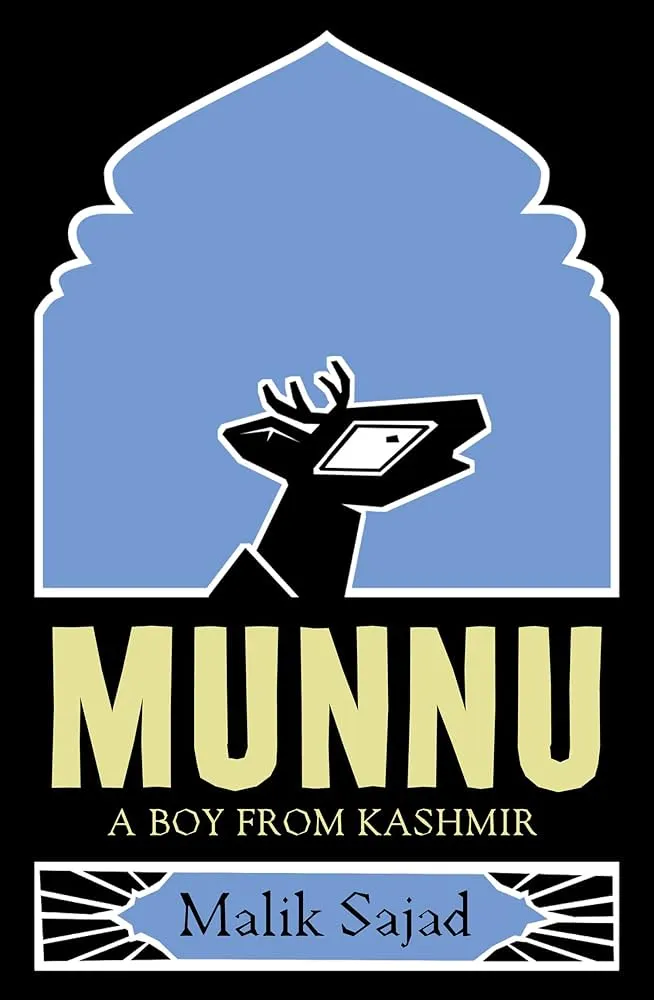
“History only rationalises the punishment you have been sentenced to.”
I have always enjoyed exploring intricate ideas while reading novels and the artistic brilliance of superhero comic books that conjure up fantastical worlds. My joy knew no bounds when I discovered that graphic novels combine the best from both worlds and instantly transport readers to a universe of their own.
It was only last year that I started reading graphic novels that revolved around serious topics. After diving into the world of western graphic novels, I wanted to read something closer to home, something closer to India. A quick Reddit search later, I came across Munnu: A Boy From Kashmir. The erudite redditors lauded it and described it as the coming-of-age story of a Kashmiri boy. This piqued my interest.
For a long time, whenever the topic of Kashmir popped up in my face through any media source, I consciously avoided it. Not that I wasn’t interested or was unsympathetic to the plight of the people in the region, but because I, from a young age, considered the topic to be so complex that it would require me to reach a certain level of maturity to wrap my head around the topic in its entirety.
As I grew up, I understood the elusiveness of the idea of “completeness”. To comprehend multiple subjective truths in their entirety is an illusion and a fool’s errand. Now that I knew this and with my recently found love for graphic novels, I decided to read Sajad Malik’s account of his life as a Kashmiri youth. I wanted to look at Kashmir through this artist’s lens.
The state animal of Jammu & Kashmir is Hangul. It is through these endangered anthropomorphic Kashmiri stags that Sajad Malik has represented the people of Kashmir. Munnu, the youngest in the family, stays with his parents, three brothers, and a sister in Batamaloo, Srinagar.
Munnu’s proclivity towards art begins from a young age when he tries to imitate carvings on the wooden blocks that belong to his father, a local artisan. When he is denied the chance to carve on the wooden blocks, Munnu picks up the pen and paper and starts sketching and tracing whatever pictures he finds in the newspapers. The pictures in the newspapers are mostly of the deformed, unrecognisable dead men.
Munnu tastes fame at a very young age when his schoolmates are impressed by his ability to sketch an AK-47. The young and impressionable school kids request him to draw the gun for them. While the teachers at his school find out that it is Munnu who is the artist behind the gun images, instead of punishing him, as he fears they would, they appreciate his work and ask him to decorate the school board and draw protest banners for the release of their school’s principal.
The narrative slowly draws us in towards the fractured Kashmiri world that is filled with army crackdowns, violent protests, mourning martyrs, and intermittent lockdowns that ravage the lives of the people in the region.
Growing up in the midst of unrest and uncertainty, Munnu experiences life. He experiences his first crush, his growing bond with his siblings, being doted upon by his grandparents, the joy of meeting new friends, and the unconditional love of his parents, especially his mother. He also experiences fear of the unknown, restrictions to his movement, curtailment of his freedom, violent deaths of people around him, unjust punishments, and the meanness, cowardice, and unpleasantness that seep into the minds of the people living in a destabilised region.
Through all the ups and downs in his life, the one thing that never leaves Munnu is his passion for art. When his elder brother, Bilal, informs Munnu about the cartoons in the local newspapers, he gets excited and, without any delay, sends in one of his artworks for publication. After his sketch is published, he gets motivated and keeps sending in more politically charged cartoons. He does all this without any pay because in his young mind, he prioritises the opportunity of publication over payment.
Soon Munnu gets a permanent job at one of the local newspapers as a cartoonist. When he is conferred his Press badge, he understands the complexities of his own region deeply. He starts meeting artists, poets, authors, and historians to gather their views about Kashmir in order to expand his knowledge. He is dazzled and confused when he listens to all of their versions of the truth.
The black and white art of the novel explores in great depth the dark grey lives and histories of the Kashmiri people. Two particular sections that caught my eye and left me dumbstruck were the narration of how the Dogra Maharaja betrayed the people of Kashmir, and the genocide and exodus of the Kashmiri Pandits and how their absence is still felt in the valley till today, creating a vacuum that can never be filled.
While the novel’s art shines, its prose only makes it better. In a chapter that explains the atrocities inflicted upon the Kashmiri Pandits, the intellectual Muslims, and anyone who supported the Kashmiri Pandits, the following line appears that discusses how the deaths of Hindus and Muslims were treated by the media:
“In the casinos of the media, statistics of death become chips to play and win debates.”
This is just an example of the exemplary prose sprinkled throughout the novel.
The ending of the novel, where Munnu realises that no one is coming to save him or the Kashmiri people, perhaps contains the most philosophical enquiries.
“Embrace the inevitable process of aging, but ditch the process of growing up. You might manage a happy ending without having to become a hero or a spiteful monster.”
The book ends on a terrible and sombre note with coldness, darkness, and uncertainty reigning supreme. It left me with a feeling of sad emptiness.
I have no in-depth knowledge about the history of Kashmir. So, I cannot claim the veracity of the incidents mentioned in the novel. However, the tale told through the lens of Sajad Malik conveys the existence of a dark reality. I have heard first-hand accounts of relatives who have visited Kashmir as tourists, claiming that things have changed for the better in the valley. Since this graphic novel was published in 2015, quite a few important political changes, like the abrogation of Article 370, have improved the lives of the people in the valley.
We may all have different political opinions, some even diametrically opposite to each other, but the existence of this novel shows that hope, no matter how dimmed, beaten, and shrivelled up, still exists in the darkness out there.
I highly recommend this book to anyone interested in reading about Kashmir.
My final rating:
If you liked the above article, please consider reading the following:
Greatness of one demands the sacrifice of two
A review of Mohan Rakesh's play आषाढ़ का एक दिन, exploring love, artistic ambition, sacrifice, and the irreversible passage of time.
आज के प्रसिद्ध शायर - निदा फाजली
A review of Nida Fazli's collected works
अक्टूबर जंक्शन
October Junction is tale by Divya Prakash Dubey that has garnered lots of love and attention from the Hindi reading world.